Viable Solutions

LA's water bucket needs a LID as well as a cork...

Tree and mulch as part of Low Impact DevelopmentCongratulations to the city of Los Angeles' Board of Public Works for taking the first step towards conserving our city's rainwater by passing a Low Impact Development [LID] plan.

This puts us on the path towards water sustainability. It still needs to be approved by the City Council, but this alone is a big step forward.

LID's primary aim is to protect water quality, but its tools can calibrated to substantially augment the supply of water for landscape irrigation, which comprises 40% to 70% of Southern California's overall use, and thus free up a substantial amount of water for the city and its residents.

While enacting a LID ordinance into law will be a critical step, the desired results and changes will occur over decades, not months or years. If Los Angeles is to respond to the threats to its health and viability posed by climate change and the long term water supply emergency, we will need to accelerate this retrofitting process.

Accelerating LID implementation represents the fastest, best way to establish a sustainable clean water supply for Los Angeles.

There's a hole in the bucket, dear Liza

Rainclouds over LAThe rains that have fallen in the past couple weeks have given Los Angeles a reprieve from the severe drought of the past three years. In a search for long-term solutions, this past week Congresswoman Grace Napolitano (38th district) convened a hearing of the House Natural Resources Water and Power Subcommittee in L.A..

Those in attendance heard testimony about a diversity of approaches. But they didn't hear much about a critical solution that could be scaled up quickly and cheaply, go far to meet our urgent water needs, and create jobs to jumpstart our economy. That solution is rainwater harvesting.

Despite L.A.'s recent abundant rainfall, experts agree that the drought is far from over. What's more, these rains didn't help L.A. as much as they could, because there's a hole in our bucket. Every time it rains, the City leaks billions of gallons of rainwater, literally throwing it away, right out to sea.

It's not only water that is hemorrhaging. We spend billions of dollars and a substantial amount of California's electricity importing L.A.'s water supply from dwindling distant sources. Making things worse, we also spend tens of millions of dollars more cleaning up pollution that's carried to the ocean by rainwater that falls on the city's over-paved landscape.

A living memorial: King Boulevard, twenty years later, a model for climate resilience action

A treeless and stark King Blvd. twenty years agoPictured at left is a treeless and stark Martin Luther King, Jr. Blvd. in Los Angeles, twenty years ago last week.

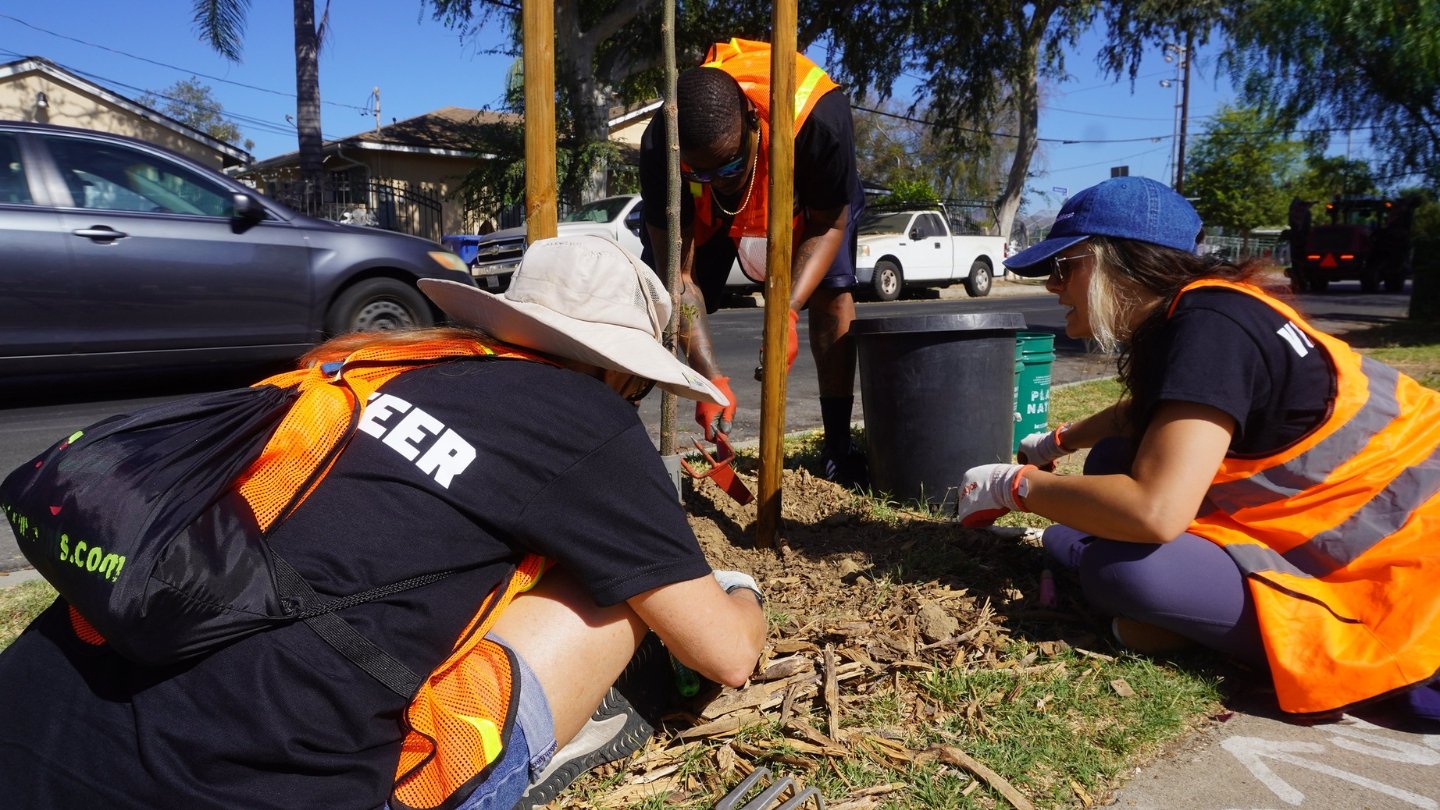
This photo was taken just before TreePeople helped organize a huge tree-planting event in honor of the great civil rights leader.  Volunteers at 1990 King Blvd. eventThe result is perhaps the largest living monument to Dr. King...but even more important, the fact that the trees are alive, thriving and beautiful today is a monument to one of Dr. King's key tenets:  sustained community engagement and action

The costs of inaction

World map of Kyoto Protocol SignatoriesThe nations of the world met last month in Copenhagen. Unfortunately, they weren't able to hammer out an agreement with binding pledges to reduce carbon emissions.

In 1997 nearly all of those same nations gathered in Japan to face up to the challenge of climate change, and most signed the Kyoto Protocol. This map from Wikipedia shows those who agreed (in green), those who abstained (in grey) and those who refused to consider the agreement (in red).

What has been overlooked are the costs of inaction. And make no mistake, we've been paying dearly.

Syndicate content